.png)


Creative Talent Work Permit in Indonesia: Clear Paths for Influencers, Models, and Production Crews 2025

Why a Clear Legal Path Matters for Today’s Global Creators
The creative industry is expanding faster than ever, from influencers signing global brand partnerships to models flying in for seasonal campaigns, filmmakers producing high-impact commercials, and content creators livestreaming across continents. As international productions and cross-border collaborations continue to rise, Indonesia has become a sought-after destination for shoots, events, festivals, and digital content creation. But with this growth comes one unavoidable requirement: the need for clean, correct, and compliant legal documentation.
Many professionals still assume that “short-term work” or “just filming content” doesn’t require proper permits. Yet misunderstandings about KITAS options, film-crew visas, drone regulations, and commercial-shoot requirements have caused unnecessary delays, fines, and even forced project cancellations. This is exactly why understanding the structure, purpose, and rules surrounding a Creative Talent Work Permit in Indonesia is essential before stepping into any commercial or creative activity.
In the following sections, this article breaks down all the essentials: the different KITAS and visa pathways available for creative professionals, how influencers and models can select the right sponsorship route, what production teams should prepare before filming, how drone rules work in restricted zones, and when commercial permits are required. By the end, creators and production managers will have a clear, practical roadmap to navigate Indonesia’s creative-sector regulations with confidence.
Understanding Indonesia’s Stay Permit Options for Creative Professionals
Before any creator, performer, or production crew enters the country for commercial work, it’s essential to understand the stay permits that Indonesia provides. These permits form the foundation of any compliant Creative Talent Work Permit in Indonesia, and selecting the right one will determine whether your activities are legally permissible and properly documented.
Indonesia’s immigration framework offers several pathways tailored to foreign workers, artists, and visiting professionals:
1. KITAS (Limited Stay Permit)
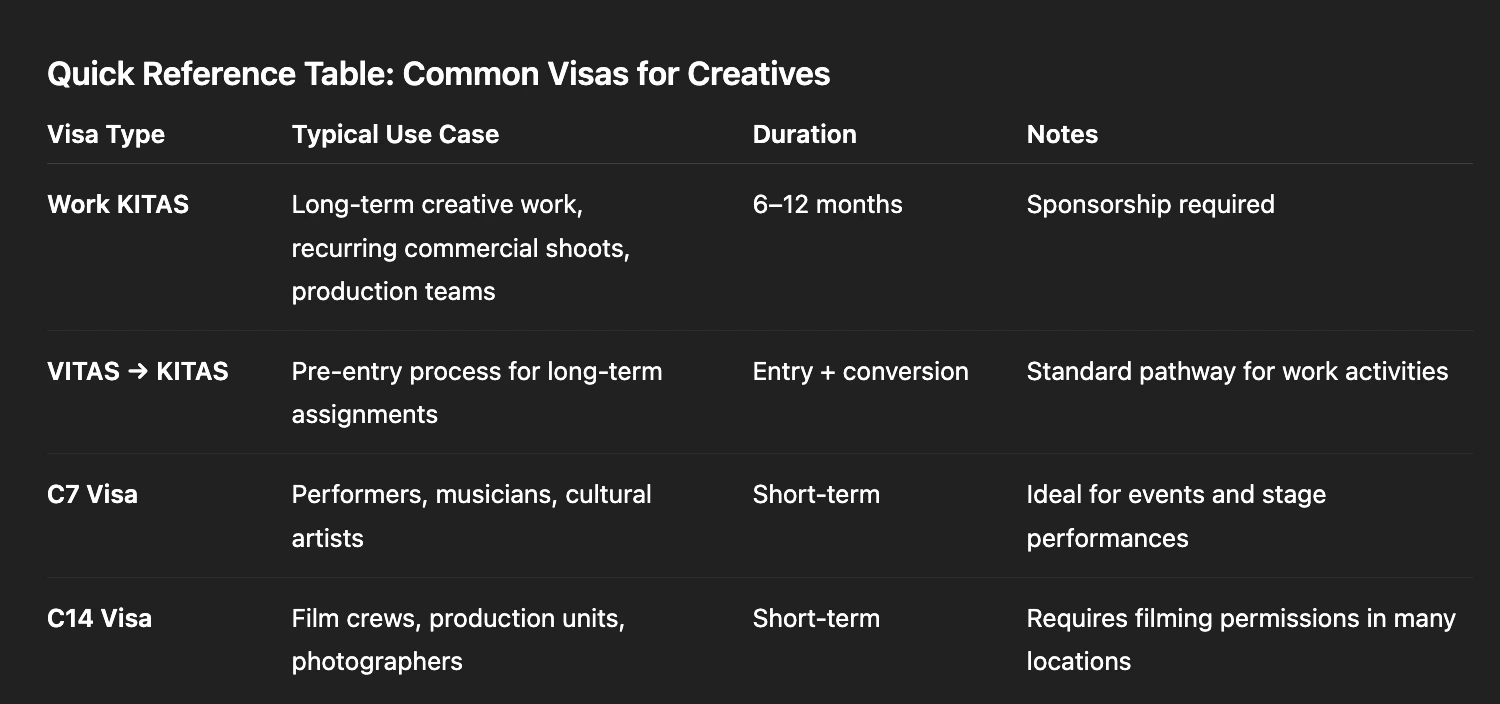
A KITAS is the most common medium-term stay permit for foreign nationals performing paid activities in Indonesia. Creative workers, models, filmmakers, digital creators, production staff, and performing artists, typically obtain a Work KITAS backed by an employer, production house, or event organizer. This permit allows legally supervised work under a registered sponsor.
2. VITAS (Visa Tinggal Terbatas)
A VITAS is the entry visa that leads to a KITAS. It is issued before arrival, then converted into a KITAS once the foreigner completes biometric and immigration procedures. For many professionals pursuing a Creative Talent Work Permit in Indonesia, the VITAS → KITAS route is the standard pathway, especially for long-term or recurring commercial engagements.
3. C-Visas for Performers and Artists (C7 / C14)
Indonesia also offers purpose-specific visas such as:
- C7 Visa - typically used for short-term performances, concerts, artistic showcases, or cultural events.
- C14 Visa - applied for when foreign film crews, documentary teams, or commercial production units enter Indonesia for temporary shoots.
These visas are designed for brief assignments, live events, and production sessions where obtaining a full KITAS may not be necessary.
KITAS Pathways for Artists, Performers & Production Talent
For many foreign creators, performers, and production teams, choosing the correct stay permit is the most crucial step in securing a Creative Talent Work Permit in Indonesia. Each KITAS category serves a different segment of the creative industry, with varying sponsorship requirements, permitted activities, and lengths of stay. Understanding these distinctions helps avoid immigration violations and ensures smooth project execution—whether you're filming a commercial, joining a festival, or working long-term with a brand.
1. Artist / Performer KITAS (Impresario / Artist KITAS)
This KITAS type is designed for foreign individuals engaged in live performances, cultural events, concerts, theater, and artistic showcases.
Who qualifies: musicians, dancers, touring performers, theatrical actors, cultural artists, and stage production personnel.
Sponsor requirements: typically a registered impresario company, event organizer, or licensed Indonesian performing arts sponsor.
Duration: usually 6–12 months, depending on project timelines.
Costs: vary based on agency fees, RPTKA/Notifikasi requirements, visa processing, and mandatory state charges.
This KITAS is ideal for creatives engaged in repeated performances or extended artistic programs across Indonesia.
2. Work KITAS via PT (PMA) or Local Sponsor
A Work KITAS through a PT PMA (foreign-owned company) or local PT is common for creators with long-term roles, such as lead content creators, brand ambassadors, creative directors, videographers, or in-house production crew.
Sponsorship must be aligned with the company’s business classification, ensuring creative or media-related activities fall under the permitted business scope. This pathway is widely used for stable, ongoing commercial work, particularly for creators attached to brands, agencies, or production studios.
3. Freelance / Specialist KITAS
In limited cases, a Freelance or Specialist KITAS may apply, depending on the profession and national manpower regulations.
Eligibility: niche creative fields such as animators, lighting specialists, stylists, editors, or technical consultants, where legally recognized.
Limitations: freelancers may still need a registered Indonesian sponsor; independent self-sponsorship is not permitted. Profession lists can vary, so individuals should verify whether their role is included in the allowable category.
4. C-Visas & Film Visas (C7 / C14)
These visas are short-term options for projects that do not require a full KITAS.
- C7 Visa: used for performers, stage artists, musicians, and talent appearing at one-off or short-run events.
- C14 Visa: common for film crews, photographers, documentary teams, and commercial production units entering for brief shoots.
Both require clear documentation of production schedules and often additional permits for protected locations.
These visa and KITAS routes are the core building blocks for a compliant Creative Talent Work Permit in Indonesia, ensuring creators can work legally while aligning with Indonesia’s evolving regulatory ecosystem.
Essential KITAS Readiness Checklist for Creators & On-Camera Talent
Applying for a KITAS as an influencer, model, performer, or content creator comes with specific administrative steps that must be properly aligned to secure a Creative Talent Work Permit in Indonesia. The process involves both the applicant and the Indonesian sponsor, and even a small mismatch, such as an incorrect business classification can delay or derail approval.
1. Sponsor Documentation & Corporate Requirements
A valid Indonesian sponsor is the backbone of any KITAS application. The sponsor, whether a PT, PT PMA, impresario company, or event organizer must provide:
- Updated company documents (NIB, Deed of Establishment, KBLI codes)
- Employment or engagement contract
- RPTKA/Notifikasi (if the creator is considered an employee)
- A Letter of Assignment or Letter of Engagement for events, productions, or brand campaigns
For short-term creatives, the sponsor may also need to submit project details, filming schedules, production call sheets, or event permits to immigration.
2. Personal Requirements & Required Translations
Influencers, models, and production talent must prepare:
- Passport with at least 18 months validity
- Current portfolio or proof of professional activity (if requested)
- Digital passport photo and biometric data
- Translated documents (certificates, contracts) when required
All translations must be done by a sworn translator to meet immigration standards.
3. Common Rejection Triggers, and How to Avoid Them
Many KITAS applications fail due to preventable issues. The most frequent triggers include:
- KBLI mismatch between the sponsor’s business scope and the applicant’s creative activities
- Lack of a skills-transfer or knowledge-sharing plan when required under manpower regulations
- Weak or incomplete sponsor documentation
- Event or production details that contradict submitted timelines
- Applicants using tourist visas for work while preparing KITAS documents
Addressing these issues early ensures the application aligns cleanly with the legal framework governing a Creative Talent Work Permit in Indonesia, reducing the risk of rejection and helping creators begin their work legally and without delays.
Visas & Permits for Production Crews, Photographers, and Film Teams
Foreign production crews, cinematographers, photographers, sound engineers, drone operators, and technical staff must follow specific visa and permitting rules when working on Indonesian soil. While creative performers typically rely on KITAS categories, crews handling cameras, lighting, staging, or documentary work often require a different pathway beyond the standard Creative Talent Work Permit in Indonesia, especially when participating in short-term film or commercial shoots.
1. C14 Film Visa & National Film Permit Requirements
For most foreign crews, the C14 Film Visa is the primary entry route. This visa accommodates short-term productions, including advertising shoots, docuseries, music videos, and travel content.
Key requirements usually include:
- A registered local production company or fixer as sponsor
- Submission of filming scripts, synopses, and production outlines
- National Film Permit approval from the Ministry of Education, Culture, Research & Technology
- Location permits from relevant regional governments, park authorities, or cultural sites
The crew must also comply with immigration’s expectation that all foreign personnel be listed transparently, unregistered crew members can trigger on-site inspections.
2. Local Fixers & Location Compliance
A local fixer plays a crucial role: securing permits, negotiating with village authorities, advising on sensitive locations, and coordinating with the Bali Film Commission or other provincial film offices. Their involvement often determines whether a production remains compliant and on schedule.
3. Contracts, Insurance & Risk Management
For film and photography crews, properly structured contracts are essential. Agreements should clarify copyright ownership, equipment responsibilities, and employment terms. Productions should also secure:
- Liability insurance
- Accident and equipment coverage
- Location-specific risk assessments
When structured correctly, these documents help ensure that film crews working under a Creative Talent Work Permit in Indonesia or using C14 visas remain compliant while protecting both the talent and the production company.
Navigating Drone Regulations & Safe Filming Standards in Indonesia
Understanding drone rules is increasingly essential for international productions, especially when coordinating aerial teams under a Creative Talent Work Permit in Indonesia.
Indonesia applies strict aviation rules through the Directorate General of Civil Aviation (DGCA), particularly for professional drone operations. Any drone weighing over 2kg must be registered, and commercial shoots often require a flight permit supported by a clear flight plan, pilot license, and valid insurance. Productions should prepare to submit specifications of the aircraft, pilot credentials, and a risk-mitigation outline. Lead time matters: approvals typically take several working days, but complex areas can require longer coordination.
Beyond national aviation rules, operators must respect restricted and sensitive zones. Prohibited areas include airports, military facilities, key government buildings, and certain high-traffic tourist landmarks such as FINNS Beach Club. In Bali and Lombok, additional considerations apply to desa adat (customary villages), where cultural sensitivity plays a major role. Some temples, ceremonial routes, and sacred sites may restrict drones entirely to preserve spiritual sanctity. Environmental protection zones, marine parks, and protected wildlife areas also enforce strict limitations.
For commercial filming, securing permits is non-negotiable. Productions must coordinate with DGCA, local tourism offices, and where applicable village authorities. A local fixer is invaluable in navigating these multi-layered approvals, ensuring compliance from paperwork to on-site protocol. Strong planning and realistic timelines help avoid last-minute setbacks.
As productions grow, aerial teams working under a Creative Talent Work Permit in Indonesia benefit from clearly structured safety procedures, responsible flight conduct, and transparent communication with authorities. These standards not only protect the crew but also uphold the reputation of the production within Indonesia’s increasingly regulated creative landscape.
Commercial vs. Non-Commercial Shoots: What Creators Must Know
Understanding shoot categories is essential for anyone operating under a Creative Talent Work Permit in Indonesia, as each type triggers different regulatory and community obligations.
In Indonesia, the line between commercial and non-commercial content determines what permits you need and how closely your production will be monitored. Editorial content, travel vlogs, behind-the-scenes clips, or unpaid social posts typically fall under non-commercial work and often require minimal approvals, though certain venues and tourist sites still impose internal guidelines.
Commercial shoots, however, involve paid advertising, brand deals, sponsored content, and professional-scale campaigns. These require more formal documentation, including location permits, potential location fees, and in some cases coordination with local agencies such as Bali Film. Many beaches, rice terraces, and hospitality properties now have structured shooting tariffs to manage production activity.
Community approval adds another critical layer. In Bali especially, shoots near villages, temples, or cultural zones often require permission from the banjar or desa adat. Productions must also respect limitations related to noise, drones, lighting setups, and shooting hours. A cultural sensitivity checklist, appropriate attire, respectful behavior around offerings, and awareness of ceremonial events helps ensure smooth operations.
With the right preparation, creators working under a Creative Talent Work Permit in Indonesia can navigate both commercial and non-commercial filming while maintaining harmony with local communities.
Tax & Payroll Obligations Every Foreign Creator Should Understand
Navigating Indonesia’s tax landscape is a core part of compliance for anyone working under a Creative Talent Work Permit in Indonesia, especially when paid collaborations or commercial shoots are involved.
Foreign creators and production professionals must account for several layers of taxation. Withholding tax (PPh 26) generally applies to payments made to non-resident talent, while resident creators holding a Work KITAS may be taxed under PPh 21 once they qualify as tax residents. Commercial shoots may also trigger VAT on services, equipment rentals, or production activities depending on the structure of the project.
Practical compliance begins with correct invoicing. Creators who work through a local entity, such as a PT or PT PMA can issue tax-compliant invoices and may need an NPWP to align with Indonesian tax systems. Meanwhile, invoicing through an offshore entity may limit certain deductions and can lead to higher withholding rates if a tax treaty does not apply.
Managing payments for talent fees, production crew, and creative services also requires clarity on reporting standards, especially when creators switch between short-term shoot visas and employment-based KITAS arrangements.
By understanding the tax and payroll implications early, creators operating under a Creative Talent Work Permit in Indonesia can avoid penalties, optimize compliance, and maintain smooth project execution.
Timelines, Costs & Common Mistakes Creators Should Avoid
Understanding the typical process behind a Creative Talent Work Permit in Indonesia helps creators plan their schedules, budgets, and project commitments with far fewer surprises. Most permits follow predictable timelines, but delays often come from missing documents or mismatched job classifications.
For reference, KITAS conversions from VITAS usually require 2 - 4 weeks, depending on immigration workload and sponsor readiness. Artist or performer KITAS packages vary widely in cost, but creators can expect fees for RPTKA/IMTA, visa issuance, and KITAS approval to fall within mid-range professional licensing costs. Drone-related approvals, including DGCA permits and location permits, often require 5 - 10 working days, while national or regional film permits may need 7 - 14 days of lead time.
The most common pitfalls include incomplete sponsor files, outdated passport validity, unclear job descriptions, film crews applying under the wrong visa type, and ignoring local desa adat or tourism-site permit requirements.
A clear checklist, realistic timelines, and transparent budgeting ensure that anyone applying for a Creative Talent Work Permit in Indonesia can avoid unnecessary delays and maintain project momentum.
Your Final Preparation Guide & Smart Next Steps
Before any shoot, performance, or brand collaboration, creators should finalize a clear one-page checklist, this is essential for anyone navigating a Creative Talent Work Permit in Indonesia. The core documents include a valid sponsor letter, signed contract or letter of engagement, proof of confirmed bookings or event schedules, active insurance coverage, and when applicable, drone registration, flight-plan paperwork, and film/location permit applications.
It’s equally important to organize translations, ensure passport validity, and secure backups of every submission. Creators and production teams who prepare these items early experience smoother approvals, fewer delays, and more predictable project timelines.
Next steps: before locking in shoot dates or publishing schedules, consult a qualified legal or immigration advisor. For those who want expert support, Synergy Pro can guide you through documentation, compliance, and permit strategy from start to finish.
Source:
FAQ

Share the blog


Related News


SYNERGY PRO Business & Legal Consulting
Social Media


