.png)


Indonesia Family Visa for Children: Guide to E31C, E31D, E31E and E31F

Moving to Indonesia with children can involve more than arranging accommodation, schools, and daily necessities. Foreign parents also need to ensure that their children's immigration status matches their family circumstances.
For families living in Indonesia, the Indonesia family visa for children framework includes several different visa categories. Among them are E31C, E31D, E31E, and E31F. Although all four are family-based visas, they are designed for different family relationships and circumstances.
Understanding which Indonesia family visa for children applies to your family is important because eligibility can depend on the child's parents, nationality, legal family relationship, the parent's immigration status, and, for certain categories, the child's age and marital status.
The Directorate General of Immigration currently lists E31C, E31D, E31E, and E31F under its Family Visa categories.
What Is an Indonesia Family Visa for Children?
An Indonesia family visa for children is a family-based immigration route that allows eligible foreign children to obtain a limited-stay status in Indonesia based on their relationship with an Indonesian citizen or a foreign parent who holds an eligible Indonesian residence permit.
The four categories discussed in this article are not interchangeable. Each Indonesia family visa for children is intended for a particular family situation.
The basic categories are:
- E31C: Child joining a parent, where one parent is an Indonesian citizen.
- E31D: Child joining a foreign parent who is married to an Indonesian citizen.
- E31E: Biological child under 18 and unmarried, joining a parent who holds ITAS or ITAP.
- E31F: Child joining an Indonesian citizen father or mother who has a recognized legal relationship with the child.
Therefore, choosing the correct Indonesia family visa for children starts with identifying the family's exact circumstances.
E31C: Child of a WNA-WNI Marriage
The E31C is designed for a child joining one parent who is an Indonesian citizen. Immigration describes it as a limited-stay visa for a child joining a parent, one of whom is a WNI.
This category can be particularly relevant to children born from a legally recognized marriage between a foreign national and an Indonesian citizen.
For families in this situation, the Indonesia family visa for children may provide a family-based immigration pathway that reflects the child's relationship with the Indonesian parent.
Parents should ensure that the marriage and parent-child relationship can be properly documented. The exact supporting documents required will depend on the circumstances and the current Immigration application process.
E31D: Child Accompanying a Foreign Parent Married to a WNI
The E31D category addresses a different situation.
It is intended for a child joining a foreign parent who is married to an Indonesian citizen. Immigration describes E31D as the visa for a child joining a foreign parent married to a WNI.
This distinction is important because E31D focuses on the child's relationship with the foreign parent and that parent's marriage to a WNI.
For families considering an Indonesia family visa for children, E31D may therefore be relevant when the child is accompanying a foreign parent who has a legally recognized marriage with an Indonesian citizen.
Parents should carefully distinguish E31D from E31C rather than assuming that every child connected to a WNI automatically uses the same visa category.
E31E: Child Joining an ITAS or ITAP Holder
The E31E category applies to a biological child joining a parent who holds an ITAS or ITAP.
One particularly important eligibility point is that Immigration describes E31E as applying to a biological child under 18 years old who is unmarried and joins a parent holding ITAS or ITAP.
This means parents should pay close attention to the child's age and marital status when considering this Indonesia family visa for children.
For example, a foreign parent legally residing in Indonesia under an eligible ITAS or ITAP may need to review whether E31E is the appropriate immigration route for their minor child.
Because age can be a determining factor, families should avoid waiting until the child approaches the relevant age threshold before reviewing their immigration options.
E31F: Child Joining a WNI Parent
The E31F category is intended for a child joining an Indonesian citizen father or mother who has a recognized legal relationship with the child.
This category is therefore distinct from simply asking whether the child has a connection to Indonesia. The legal relationship between the child and the WNI parent is an important consideration.
For parents researching an Indonesia family visa for children, E31F should be assessed based on the specific legal and documentary circumstances surrounding the parent-child relationship.
Immigration's current service information specifically identifies E31F as a limited-stay visa for a child joining a WNI father or mother who has a legal relationship with the child.
E31C vs E31D vs E31E vs E31F
The differences become easier to understand when looking at the family situation rather than focusing only on the visa codes.
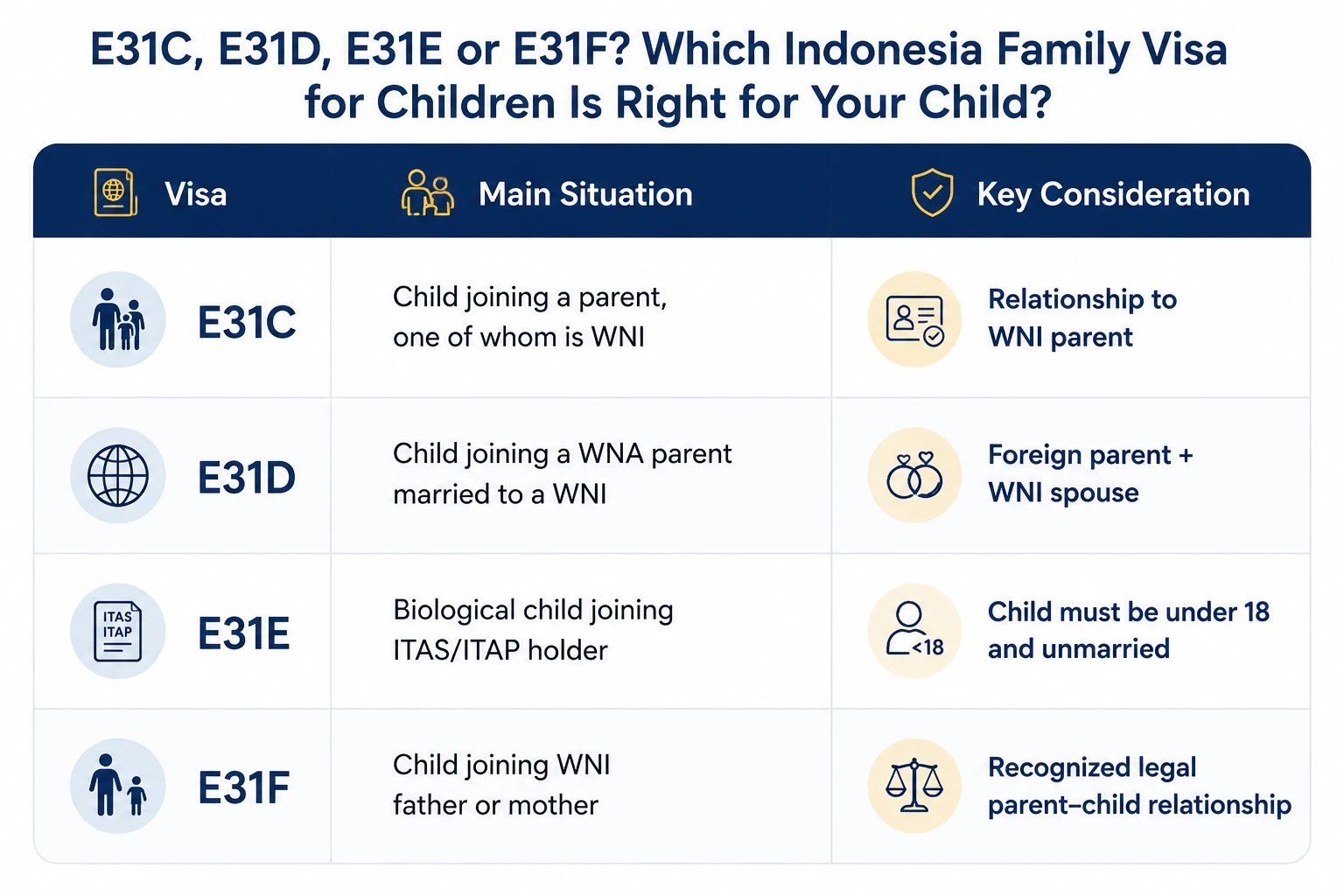
This comparison demonstrates why there is no single Indonesia family visa for children that applies to every foreign child living in Indonesia.
What Documents May Be Required?
Supporting documentation depends on the specific visa category and the family's circumstances. However, applicants should generally be prepared to demonstrate the relevant family relationship and immigration basis.
Depending on the case, documentation can include:
- Valid passport
- Birth certificate
- Marriage certificate of the parents, where relevant
- Indonesian parent's identity or citizenship documents
- Foreign parent's ITAS or ITAP, where relevant
- Evidence of the legal parent-child relationship
- Other documents requested through the immigration application system
Documents issued outside Indonesia may also need appropriate legalization, authentication, translation, or other formalities depending on the document and current requirements.
Because documentation requirements can change depending on the applicant's circumstances, families should verify the current requirements before submitting an Indonesia family visa for children application.
Who Can Sponsor the Child?
The appropriate sponsor or guarantor depends on the visa category and the family relationship involved.
For an Indonesia family visa for children, the relevant Indonesian parent or eligible foreign parent may have a role in supporting the application, depending on the applicable category.
This is another reason why parents should not select an E31 category solely based on a general description found online. The applicant's family structure, parent's immigration status, and supporting documents should be reviewed together.
Why Choosing the Correct Visa Matters
Selecting the correct Indonesia family visa for children is more than an administrative matter. The visa category establishes the legal basis for the child's stay in Indonesia.
Using an inappropriate category or submitting incomplete documentation can result in delays, additional requests for documents, or the need to reconsider the application.
Parents should also monitor their child's immigration status after approval. Changes in circumstances, such as a child reaching a certain age, changes in parental immigration status, changes in marital circumstances, or changes in citizenship status, may affect future immigration options.
What About Children With Indonesian Citizenship Rights?
Some children with Indonesian and foreign parentage may have issues involving Indonesian citizenship or dual-nationality registration rather than simply an Indonesia family visa for children.
This is particularly important because immigration status and citizenship status are not the same thing.
In 2026, Indonesian Immigration also announced the continued digitalization of services involving children with dual citizenship, including registration and related immigration facilities through the eVisa system.
Therefore, parents of children with potential Indonesian citizenship rights should first determine the child's citizenship position before deciding which immigration route is appropriate.
Indonesia's Current Immigration Framework
Indonesia's visa and residence-permit system is governed by a combination of immigration legislation and implementing regulations.
Permenkumham No. 22 of 2023 on Visa and Stay Permits, as amended by Permenkumham No. 11 of 2024, establishes the regulatory framework for Indonesian visas and stay permits.
The government has also continued to update immigration administration through regulations issued by the Ministry of Immigration and Corrections. For example, Permen Imipas No. 3 of 2025 regulates visa, stay permits, facilities, and immigration supervision for diaspora categories and specifically includes children from legally recognized marriages between foreign nationals and Indonesian citizens within its scope.
This evolving regulatory environment makes it important for families to check the latest official requirements when applying for an Indonesia family visa for children.
Which E31 Visa Is Right for Your Child?
There is no universal answer.
If one parent is Indonesian, the family may need to examine E31C or E31F, depending on the specific legal relationship and circumstances.
If the child is accompanying a foreign parent who is married to an Indonesian citizen, E31D may be relevant.
If the child is a biological child under 18 and unmarried and is joining a parent holding ITAS or ITAP, E31E may be the appropriate category.
The correct Indonesia family visa for children ultimately depends on the facts of each family.
Before submitting an application, parents should review the child's passport, birth certificate, parents' citizenship, marriage documents, parent's immigration status, and any applicable age requirements.
For families relocating to Bali or elsewhere in Indonesia, getting the immigration basis right from the beginning can help avoid unnecessary complications later.
Source:
FAQ

Share the blog


Related News


SYNERGY PRO Business & Legal Consulting
Social Media


